
BLOG
- Home
- Blog
- Powders Article
- Summary of hardening additives for PP plastic
Summary of hardening additives for PP plastic
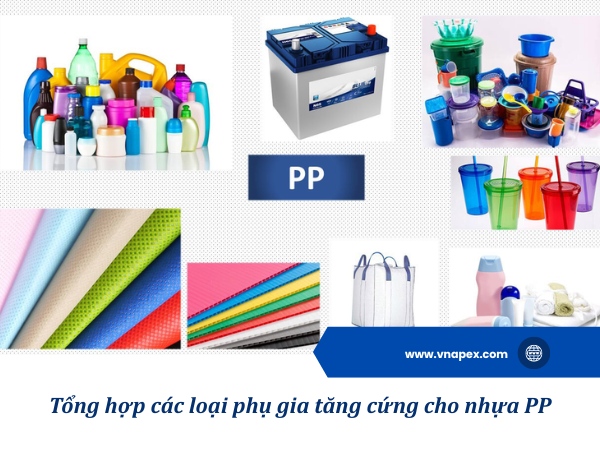
Hardening additives for PP plastic are a crucial technological solution that enhances durability, reduces shrinkage, and improves product quality in the polypropylene (PP) plastic manufacturing process. With the increasing consumption of PP plastic in many industries, optimizing the mechanical properties of products by using appropriate additives is essential for plastic manufacturing businesses today.
Common types of hardening additives used in PP plastic production include:
When mixed into PP plastic, talc granules create a mechanical reinforcement effect.

CaCO3 improves color adhesion, resulting in a more uniform product surface.

Nucleator nucleates crystals during the cooling process of PP plastic.

Why should hardening additives be used for PP plastic?
Our main product lines include:
APEX Vietnam always accompanies customers in researching, improving formulas, and optimizing production processes to meet the stringent requirements of domestic and international markets. Contact us today for advice on the most suitable hardening additive solution for PP resins for your business!
Types of hardening additives for PP plastic
Hardening additives are substances added to PP plastic to increase its strength, resistance to deformation, and reduce shrinkage after processing without affecting the quality or processing of the raw material.Common types of hardening additives used in PP plastic production include:
Talc
Talc is a mineral with a thin, lamellar structure and a Mohs hardness of approximately 1, which allows for good dispersion in resin matrices.When mixed into PP plastic, talc granules create a mechanical reinforcement effect.
- How it works: When mixed into PP plastic, the talc particles orient themselves parallel to the flow of molten plastic, creating a mechanical strengthening and shape stabilization effect.
- Uses:
- Increase product rigidity and dimensional stability.
- Reduces volume shrinkage and deformation after machining.
- Improved thermal stability, surface roughness, and scratch resistance.
- Application: Commonly used in automotive parts, household appliances, and electronic device casings where high dimensional stability is required.
Canxi Cacbonat
CaCO3 is a high-density, white, and highly dispersed inorganic mineral powder, often in the form of a granular additive (masterbatch) with a CaCO3 content of up to 85%.- How it works: When evenly dispersed in the plastic matrix, CaCO3 acts as a reinforcing material, while simultaneously reducing shrinkage stress and stabilizing the geometric structure.
- Uses:
- Increase the stiffness and shape stability of PP products.
- Reduced raw material costs by partially replacing the resin matrix with cheaper minerals.
- It prevents warping, improves color fastness, and helps create a uniform product surface.
- Application: Widely used in plastic packaging, household plastics, injection molded products, and industrial plastic sheets.
CaCO3 improves color adhesion, resulting in a more uniform product surface.
Nucleator
Nucleator (Crystallization nucleating agents) are a group of organic or inorganic compounds capable of nucleating crystals during the cooling process of PP plastic.- How it works:When added to molten plastic, nucleators accelerate crystallization and reduce crystal particle size, thereby improving the transparency and hardness of the product.
- Application:
- Increased crystallization speed, shortening processing cycles.
- Increased hardness, surface finish, and transparency of the material.
- Helps the product achieve higher thermal and mechanical stability.
- Application:Often used for thin packaging, food containers, and products requiring high aesthetic appeal and transparency.
Nucleator nucleates crystals during the cooling process of PP plastic.
Thermal stabilizers
Among the various types of hardening additives for PP plastic, heat stabilizers are organometallic compounds (such as tin, zinc, and calcium salts) or antioxidants that can inhibit the degradation of polymers due to heat.- How it works:They prevent oxidation reactions and polymer chain breakdown during processing or when the product is exposed to high temperatures for extended periods.
- Uses:
- It prevents thermal aging, helping to keep the plastic from discoloring or becoming brittle when heated repeatedly.
- Increase product lifespan in harsh environments (high temperature, UV rays, humidity).
- Application:Used in outdoor products, automotive components, water pipes, electrical and electronic materials.
Why should hardening additives be used for PP plastic?
Adding hardening additives to PP plastic is an effective technical solution to improve the mechanical properties, dimensional stability, and processability of the material.Increase stiffness and load-bearing capacity.
Hardening additives strengthen the polymer structure, increasing the elastic modulus and mechanical load-bearing capacity, helping PP products resist deformation, breakage, or cracking under impact or high pressure.Improve overall durability
The addition of appropriate additives helps PP plastic resist degradation of its physical properties when exposed to high temperatures, UV rays, or corrosive chemicals, thereby extending its lifespan and maintaining product stability during use.Reduce shrinkage and warping after machining.
In the injection molding process, additives play a role in stabilizing the geometric structure, reducing internal stress in the material, helping to limit volume shrinkage, warping, and surface deformation, ensuring that the product has precise dimensions and a uniform surface.Why should hardening additives be used for PP plastic?
Enhance the aesthetics and surface quality.
Some additives also increase gloss, transparency, and color dispersion, helping the product achieve high optical and aesthetic effects, suitable for applications requiring a smooth, bright, and uniformly colored surface.Shorten processing cycles and increase production efficiency.
Additives can accelerate crystallization and product shaping, shortening cooling time, thereby optimizing productivity, reducing energy consumption, and lowering production costs.Expanding the range of applications for PP plastic.
With comprehensive improvements in mechanical properties, thermal stability, and aesthetics, PP plastics containing hardening additives can be applied in the automotive industry (bumpers, dashboards, interior details), household appliances, technical packaging, electrical and electronic components, and heat-contact products.Application of hardening additives for PP plastic
Hardening additives for PP plastic are now widely used in many industrial fields such as:- Automotive industry: Hardening additives are widely used in the production of automotive interior components such as dashboards, door handles, side skirts, and decorative parts.
- Pipe and fitting products:Additives help increase the pressure resistance of PP-R and PP-H pipe walls, limiting deformation during welding or operation at high temperatures.
- Household goods and stationery: Commonly used in household and stationery products such as storage boxes, plastic shelves, coat hangers, and plastic spoons or forks.
- Food packaging: This helps the material achieve high transparency, a glossy surface, and good strength. As a result, food packaging boxes, cups, trays, and films can meet stringent requirements for safety, performance, and visual appeal.
APEX Vietnam provides reputable plastic additives and fillers.
APEX Vietnam belongs to the APEX Group (Taiwan) - a pioneering brand in the field of inorganic additives and masterbatch with over 50 years of experience in research, production and application of engineering plastics.Our main product lines include:
- Filler Masterbatch PP/PE –Hardening additives increase durability and optimize production costs.
- Ultra-fine Calcium Carbonate (CaCO3) powder – a high-quality raw material for the plastics, rubber, paint, and construction materials industries.
- PVC Compound & OEM service – custom manufacturing, ensuring compliance with each customer's specific technical standards.
APEX Vietnam always accompanies customers in researching, improving formulas, and optimizing production processes to meet the stringent requirements of domestic and international markets. Contact us today for advice on the most suitable hardening additive solution for PP resins for your business!
Article Classification
Recent Articles
- Comparing Talc and Calcium Carbonate Powder in Plastic Formulations
- What Is Paint Viscosity? Influencing Factors and Control Methods
- Important Applications of Calcium Carbonate Powder in Paper Manufacturing
- Calcium Carbonate Powder in Rubber Manufacturing: Applications and Benefits
- Applications of CaCO₃ in Various Industries