
BLOG

- Home
- Blog
- Powders Article
- Comparing Talc and Calcium Carbonate Powder in Plastic Formulations
Comparing Talc and Calcium Carbonate Powder in Plastic Formulations
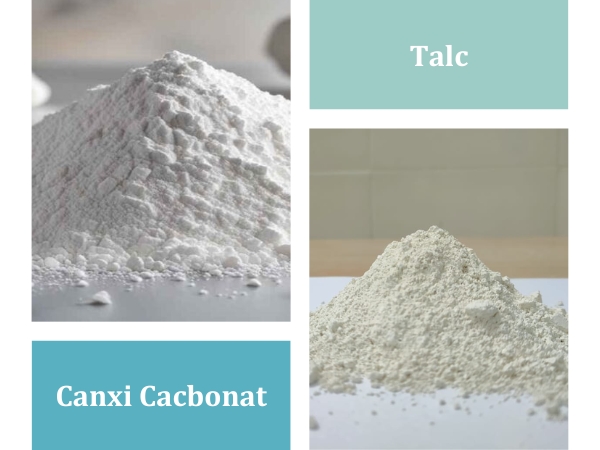
In today’s plastics industry, Talc and Calcium Carbonate powder serve as essential fillers that significantly enhance the mechanical, thermal, and surface properties of plastic products. These materials not only improve production efficiency and reduce costs but also expand the versatility of plastics across various applications. This article explores the key differences between these two fillers in plastic formulations, providing insights to help businesses choose the most suitable solution for their manufacturing processes.
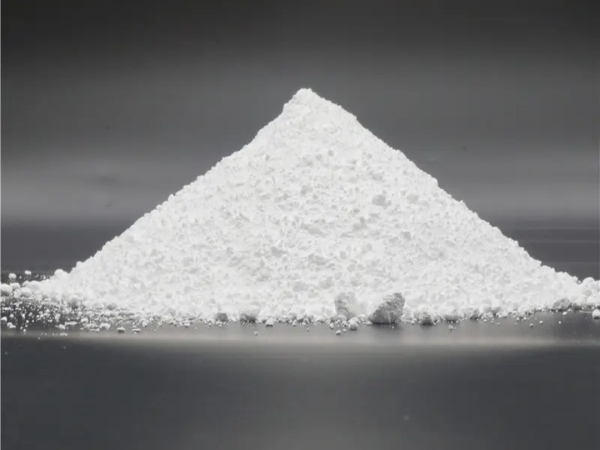
Talc powder has excellent moisture absorption, low friction, and heat resistance
Overview of Talc and Calcium Carbonate Powder
Talc and Calcium Carbonate powder are two widely used fillers across various manufacturing industries today. They play a crucial role in enhancing product performance and improving production processes, thereby delivering significant benefits in cost optimization and overall manufacturing efficiency.Talc powder
Talc powder is a naturally occurring mineral with a fine texture, typically white or off-white in color, odorless, and smooth to the touch. Due to its excellent moisture absorption, low friction, and heat resistance, talc is widely used in the plastics, rubber, and coatings industries, among others.Talc powder has excellent moisture absorption, low friction, and heat resistance
Physical and chemical properties:
Physical and chemical properties: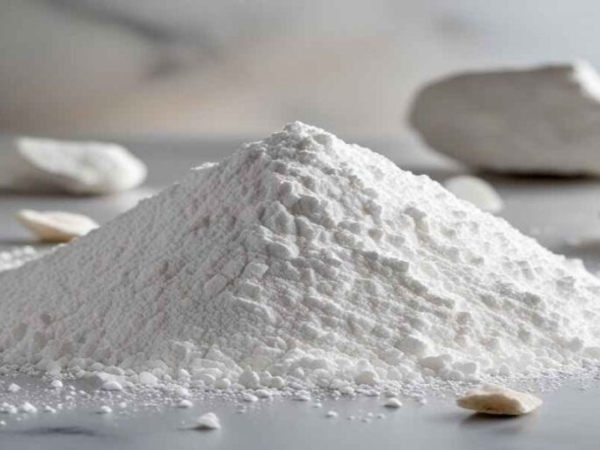
Calcium carbonate is insoluble in water but soluble in acids
- Chemical formula: Mg₃Si₄O₁₀(OH)₂
- Color: Typically white, but the powder may have greenish, grayish, or yellowish hues depending on impurities.
- Hardness: The softest naturally occurring mineral, with a Mohs hardness of only 1, giving it a soft, smooth, and silky feel to the touch.
- Solubility: Insoluble in water, ethanol, and most dilute acids and alkalis, indicating high chemical stability.
Calcium Carbonate
Calcium carbonate is a white, odorless, and tasteless inorganic powder, known for its high purity and exceptional whiteness. With its hardness, durability, and chemical stability, calcium carbonate is one of the most widely used minerals in modern industry, ranging from plastics, coatings, and paper to rubber and construction materials.Physical and chemical properties:
- Chemical formula: CaCO₃
- Appearance: Fine, white powder, odorless
- Hardness: 3 on the Mohs scale – harder than talc powder
- Solubility: Insoluble in water, but reacts with acids, releasing CO₂ gas
- Decomposition temperature: Approximately 825 - 900°C, at which point CaCO₃ decomposes into CaO and CO₂
Calcium carbonate is insoluble in water but soluble in acids
Comparing Talc and Calcium Carbonate Powder in Plastic Formulations
Talc and Calcium Carbonate powder are two essential fillers in the plastics manufacturing industry. Both contribute to enhancing material properties, yet their distinct characteristics make them suitable for different applications. The following provides a detailed comparison between these two commonly used fillers.Impact on plastic properties
Both talc and CaCO3 provide excellent reinforcement for plastics. However, talc is preferred in applications requiring high heat resistance and dimensional stability, while CaCO3 is favored for products that need a smooth surface, bright whiteness, and high opacity.| Type of Filler | Impact on Plastic Properties |
Talc Powder |
- Dimensional stability: Reduces warping and shrinkage during processing. |
| - Improves impact resistance: Helps plastics withstand sudden forces better. | |
| - High heat resistance: Enhances thermal stability, especially in high-temperature environments. | |
| - Reduces friction: Acts as a lubricant, facilitating injection molding and easy mold release. | |
| - Reduces thermal expansion: Minimizes deformation from temperature changes. | |
| - Wear resistance: Increases long-term durability of products. | |
| - Chemical resistance: Improves resistance to certain chemicals. | |
| - Fatigue resistance: Helps materials maintain performance under repeated loading. | |
Calcium Carbonate (CaCO₃) |
- Enhances impact strength: Improves resistance to cracking under stress. |
| - Increases whiteness and opacity: Creates bright surfaces, particularly useful in films and coatings. | |
| - Reduces shrinkage: Minimizes the risk of shrinkage during cooling. | |
| - Improves surface smoothness: Provides a more uniform and polished finish. | |
| - Enhances heat resistance: Slightly improves thermal performance in moderate temperature applications. | |
| - Increases moisture barrier: Limits water and gas penetration through plastic materials. |
Processing efficiency
Processability refers to how easily a material can be melted, molded, or extruded during production. Both talc powder and CaCO₃ significantly improve this property. Shorter production cycles reduce energy consumption and material waste, contributing to lower overall manufacturing costs.- Talc powder: Suitable for a wide range of plastic manufacturing technologies, such as injection molding and extrusion.
- Calcium Carbonate (CaCO₃): Provides high stability during shaping processes, particularly effective in bottle blowing, film casting, or sheet extrusion.
Economic efficiency
When choosing between talc powder and CaCO₃, cost is always a key consideration. Material prices directly impact total production costs, so careful calculation is essential.- Talc powder: Generally more expensive due to complex mining and processing methods. However, its superior reinforcement properties help save energy during production and reduce equipment wear.
- Calcium Carbonate (CaCO₃): More affordable and widely available on the market, making it suitable for manufacturing operations of all scales—from small to large.
Should You Choose Talc Powder or Calcium Carbonate?
Both talc powder and calcium carbonate offer significant benefits in production processes across various industries today. Choosing between these two fillers should be based on technical requirements and the specific needs of the final product.- For high hardness and structural durability: Calcium carbonate is the ideal choice, as it increases hardness and mechanical strength while keeping production costs low.
- For impact resistance and dimensional stability: Talc is the preferred option due to its excellent reinforcing properties, helping products withstand stress, minimize deformation, and maintain durability throughout their lifecycle.
Article Classification
Recent Articles
- Comparing Talc and Calcium Carbonate Powder in Plastic Formulations
- What Is Paint Viscosity? Influencing Factors and Control Methods
- Important Applications of Calcium Carbonate Powder in Paper Manufacturing
- Calcium Carbonate Powder in Rubber Manufacturing: Applications and Benefits
- Applications of CaCO₃ in Various Industries