
NEWS & EVENTS

- Home
- News
- Products Information
- Why do prices for CaCO₃ vary among different suppliers?
Why do prices for CaCO₃ vary among different suppliers?
August 08,2026
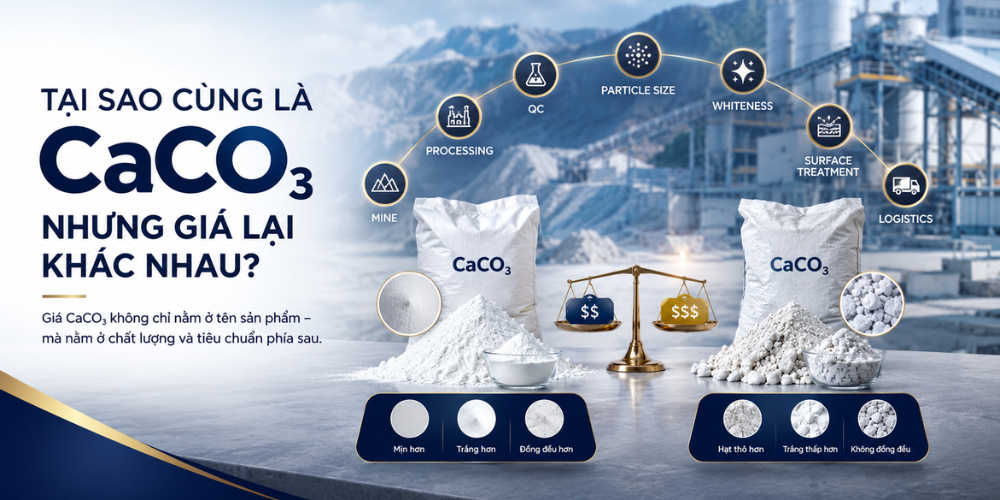
When sourcing CaCO₃ (calcium carbonate), many businesses often notice a clear trend: despite the material being the same, price quotes vary significantly among suppliers. This leads many to ask, "If it is the same CaCO₃, why do the prices differ?"
In reality, the price of CaCO₃ depends not only on the product name but also on the raw material source, CaCO₃ content, whiteness, particle size, production technology, and the technical requirements of specific industries.
1. Raw material sources and mineral quality
The quality of CaCO₃ begins with the raw stone source. Each quarrying area yields stone with distinct mineral characteristics regarding purity, whiteness, and impurity content. Stone sources with high CaCO₃ content, superior whiteness, and low impurity levels typically require less processing and are suitable for applications demanding consistent quality. Consequently, the raw material source is a key factor directly influencing the product's cost.
2. Whiteness and CaCO₃ content
Not all CaCO₃ powders share the same level of whiteness or CaCO₃ content. Industries such as plastics, paints, rubber, and paper have widely varying requirements regarding whiteness and purity. CaCO₃ products characterized by high whiteness, consistent CaCO₃ content, and low impurity levels typically command higher prices than standard grades. However, it is crucial for businesses to select the quality that best suits their specific application, rather than simply comparing prices on a per-kilogram basis.
3. Particle size and fineness
Particle size also significantly affects the price of CaCO₃. Finer products typically require more precise grinding, classification, and particle size control systems.
For certain applications, fineness and particle size distribution can affect dispersibility, product stability, and manufacturing efficiency. Consequently, two CaCO₃ products with different specifications will not command the same price.
4. Standard CaCO₃ and coated CaCO₃
Another factor contributing to price differences is surface-coated CaCO₃. Compared to standard CaCO₃, the coated product requires an additional surface treatment step to enhance compatibility and dispersion within certain resin or polymer systems.
Due to the additional materials and processing steps, the price of coated CaCO₃ is generally higher than that of uncoated CaCO₃.
5. Production technology and quality control standards
Product pricing also reflects, in part, the supplier's production and quality control systems. Factors such as batch-to-batch consistency, particle size analysis, whiteness, moisture content, CaCO₃ content, and impurity control can all influence production costs.
For businesses that use raw materials in large volumes, consistency across shipments is sometimes even more important than securing the lowest price.
You shouldn't look only at the price per kilogram.
Therefore, when comparing CaCO₃ price quotes, businesses should not focus solely on the price per kilogram. A lower-priced product that is incompatible with the formulation or causes production inconsistencies can actually increase real costs.
Instead, one should simultaneously consider CaCO₃ content, whiteness, fineness, particle size, product type, batch-to-batch consistency, and the specific application.
CaCO₃ products may share the same name, but they do not necessarily possess the same quality or utility. Selecting the right type of CaCO₃ from the outset enables businesses to strike a balance between raw material costs, production efficiency, and final product quality.